How to Find Your Real SaaS Competitors (Beyond G2 and Feature Comparisons)
Learn how to find SaaS competitors using Google, G2, sales calls, Reddit, and customer workflows. Discover alternatives beyond your product category.
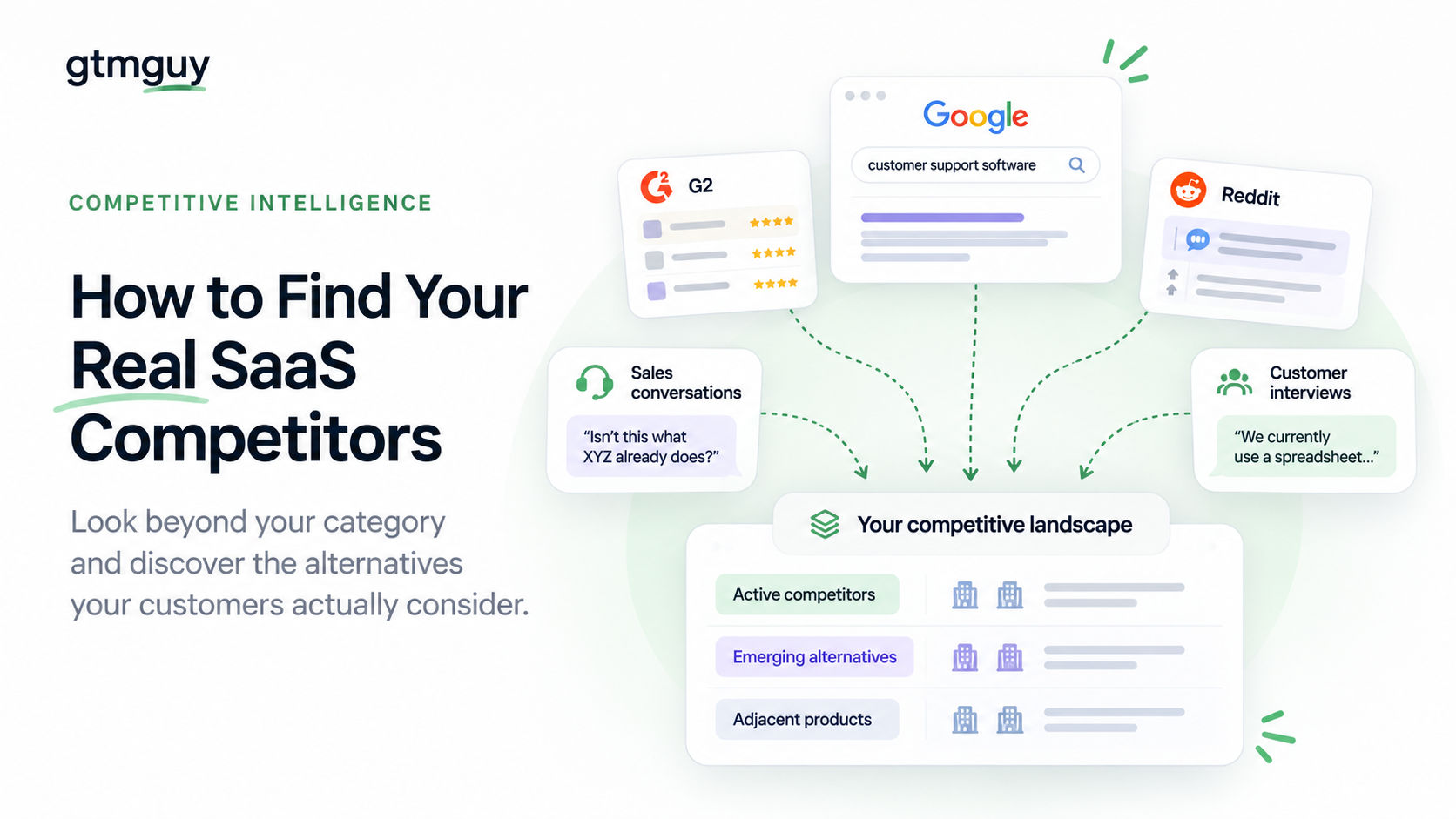
A common mistake I see early-stage SaaS companies make is identifying three or four established products in their category, building a feature comparison matrix, and giving themselves more green ticks than everyone else. The assumption is that having more features, or offering them at a lower price, automatically makes their product more competitive. But there's a more fundamental question worth answering before building that comparison: Are these the products your customers are actually considering? During a recent consulting engagement, I was reviewing a company's SWOT analysis and noticed something interesting. They were comparing themselves against products from different categories, claiming feature-level superiority, and positioning themselves as a new category. But further research revealed that the category they wanted to create already existed. Other companies were already positioning themselves within it, including some that were more relevant competitors than those featured in the original SWOT analysis. The problem wasn't necessarily their product or their differentiation. It was that their understanding of the competitive landscape was incomplete. Finding competitors requires more than searching for products that look similar to yours. You need to understand what your customers are trying to accomplish, how they're solving that problem today, and which alternatives they're likely to evaluate. Here's how to approach that research. Start with the problem your customers are trying to solve Before opening G2 or searching for competing products, I'd start by understanding the customer's existing workflow. What are they trying to accomplish? How are they getting it done today? Where does their existing approach fall short? These questions matter because customers don't necessarily begin their buying journey by looking for products in a particular software category. They begin with a problem. Consider a small business looking for a CRM. Its immediate need might not be sophisticated sales automation or pipeline forecasting. It could simply be struggling to keep track of leads and follow-ups. Today, that business might be managing its contacts through Google Sheets, Notion, or even a combination of email and reminders. In this situation, a dedicated CRM isn't just competing against other CRM products. It's competing against the customer's existing workflow. That doesn't mean Google Sheets and Salesforce should automatically appear in the same competitive matrix. Their capabilities, intended uses, and customers can be very different. But if your potential customers are deciding between continuing with spreadsheets and paying for your CRM, spreadsheets are a relevant alternative in that buying decision. This distinction helps you discover competitors beyond your immediate product category. Start with a simple Google search. Challenge your assumptions. One of the simplest ways to discover competitors is also something we often overlook: searching Google for the software category we believe our product belongs to. Early-stage companies often start competitive research with preconceived ideas. We already have a few competitors in mind, believe we understand their limitations, and assume nobody else can solve the problem quite like we do. That bias can narrow our research before it even begins. Instead, start with a basic Google search for the category you're targeting. If you're building a customer support platform, search for terms like customer support software, AI customer support platform, or B2B customer support tools. Look at which companies appear in the search results. Don't restrict yourself to the familiar names. Explore the websites of products you haven't heard of and understand how they're positioning themselves. I'd initially list these companies without worrying too much about whether they're direct competitors. The objective is to understand the existing market before deciding where your product fits. This exercise can reveal two important things. First, you might discover competitors you didn't know existed. Some could be building something remarkably similar to your product, targeting the same customers, or solving the same problem through a different approach. Second, you might start questioning whether you've chosen the right product category. Perhaps the companies appearing in search results serve a different customer segment, solve a narrower problem, or represent only a small part of the workflow your product addresses. That doesn't automatically mean you need to create a new category. It means you should investigate whether customers would naturally look for your solution under that category, or whether another existing category describes it better. Google results aren't a definitive representation of the market. Rankings are influenced by SEO, advertising, location, and search intent. But they're a useful reality check on the assumptions you bring into competitive research. Before claiming that you're creating a new category or that existing competitors can't do what your product does, it's worth understanding who already occupies that space. Use G2 and Capterra to establish your initial competitor list Once you've explored the category through Google, review platforms are another useful way to understand the competitive landscape. I usually begin with G2, Capterra, or other review sites relevant to the industry. Search for your primary software category and identify the products that consistently appear. Then explore adjacent categories, alternative product listings, and customer reviews to understand where their capabilities overlap. For example, if you're researching customer support software, you might discover related products under helpdesk, customer service, shared inbox, or customer engagement categories. These aren't necessarily interchangeable products, but they can reveal how the market is organized and which companies are addressing overlapping problems. There is an important limitation, though. According to G2's categorization methodology, products are categorized primarily by their functionality rather than every possible use case or audience. That's useful for organizing software, but it also means a product that solves the same customer problem through a different approach might not appear in your initial search. Treat review platforms as a way to establish the competitive landscape, not as a definitive list of everyone you're competing against. I also wouldn't rely too heavily on rankings. A category leader with thousands of reviews isn't necessarily the product that your specific ICP considers most frequently. Listen to how prospects describe your competitors Sales conversations are one of the most useful sources of competitive intelligence because they show how potential customers perceive your product. Pay particular attention to situations where prospects mention another product without being prompted. You might be explaining your product when someone asks: "Isn't this what XYZ already does?" Or: "How is this different from ABC?" These questions are valuable because the prospect has already connected your product to another solution in their mind. Regardless of whether you consider that company a direct competitor, your prospect clearly sees some overlap. I'd capture those mentions and examine the context. Was the prospect comparing specific capabilities? Did they believe both products could solve the same problem? Were they actively evaluating the alternative, or simply asking for clarification? Those distinctions matter. A passing mention doesn't necessarily establish strong competition. But if the same company starts appearing across multiple sales conversations, particularly within your target customer segment, it deserves closer attention. Win/loss analysis can provide additional evidence. Understanding which products customers evaluated, why they chose them, and what influenced their decisions helps distinguish actual competitors from companies that merely look similar on paper. The strongest competitive insights often emerge when you understand why customers compared two products, not simply how often a competitor's name appeared. Use Reddit and online communities to discover alternatives Another research method I find particularly useful is looking through Reddit, industry forums, and community discussions. Instead of searching for your software category, search for the problem your product solves. For example, if you're researching CRM competitors, search for discussions around managing leads, missing follow-ups, maintaining customer records, or replacing spreadsheets. The comments can reveal products, workflows, and alternatives that don't necessarily appear in your category research. A useful example is this discussion in r/CRM. The author describes managing leads in Google Sheets and struggling with missed follow-ups as the business grows. They're looking for a CRM, but they're also concerned about complicated pricing, implementation effort, and whether they can continue working within Google Workspace. This tells us something useful about the buying situation. The customer isn't simply comparing CRM features. They're evaluating whether moving away from their existing spreadsheet workflow is worth the additional cost and effort. For a startup building a lightweight CRM, this could be an important competitive insight. Its messaging might need to address switching effort and ease of adoption, rather than focusing exclusively on feature superiority against established CRMs. Of course, one Reddit discussion isn't evidence of widespread customer demand. Community posts are useful for identifying hypotheses, understanding customer language, and discovering alternatives worth investigating. You still need to validate whether those patterns are representative of your target market. Reverse-engineer the customer's workflow through search Earlier, we used Google to understand the category we believed our product belonged to. There's another useful approach: searching for the customer's problem without mentioning the software category at all. For example, instead of searching only for "best CRM software," try: How do small businesses manage leads without a CRM? How to stop missing customer follow-ups Alternatives to spreadsheets for customer tracking Tools for managing client relationships in Google Workspace These searches can surface products from different categories, industry-specific solutions, and manual approaches that buyers might consider. AI search engines can also help generate an initial list of companies or alternative workflows, especially when the problem spans several software categories. However, I wouldn't treat an AI-generated competitor list as verified research. Models can include outdated products, misclassify companies, or suggest tools that don't actually address your use case. Verify promising results against the companies' current websites, product documentation, and credible customer evidence. And don't assume every search result represents a competitor. What matters is whether the alternative is relevant to the same buyer, problem, and purchasing decision. Not every similar product is a competitor worth monitoring By this stage, you'll probably have identified more companies than you initially expected. Some will compete directly with your product. Others will solve the same problem through different workflows. A few might offer overlapping capabilities without being meaningful alternatives for your target customers. The next step is deciding which companies deserve attention. I prefer separating them into three groups.
| Competitor group | How to identify them | What to do |
|---|---|---|
| Active competitors | Appear in customer evaluations, match your ICP, or solve the same purchasing-critical problem | Monitor regularly |
| Emerging alternatives | Address a similar customer problem, but have limited evidence of direct buyer overlap | Investigate periodically |
| Adjacent products | Share features or broad use cases, but little evidence of competing for the same buying decision | Keep on your research list |
This prevents your competitive monitoring process from becoming unnecessarily complicated. For smaller SaaS teams, tracking every company with overlapping features isn't realistic or particularly useful. I'd prioritize competitors that prospects mention spontaneously, products that frequently appear in win/loss research, and alternatives that solve an important customer problem through a similar or meaningfully different workflow. The question isn't whether a company has enough overlapping features to qualify as a competitor. It's whether customers could reasonably choose that product, or their existing approach, instead of yours. A new competitor doesn't always need to appear in a lost deal One qualification worth making is that an emerging competitor might deserve attention before it starts appearing frequently in your sales conversations. Suppose a product begins targeting your ICP, introduces a workflow that directly addresses a major customer problem, and starts appearing in relevant community recommendations. Even without confirmed lost deals, that could be enough to investigate the company. The distinction is between investigating a possible competitor and committing resources to actively monitoring it. You don't need the same level of evidence for both decisions. Keep your competitive landscape up to date Identifying competitors isn't a one-time exercise. Companies change their positioning, expand into new markets, launch products, and introduce pricing plans that attract different customer segments. A company that wasn't relevant to your ICP six months ago might become a direct competitor after introducing a new workflow or changing its target audience. That's why I recommend periodically revisiting your competitor list and looking for evidence that relationships between products are changing. You don't need to repeat the entire discovery exercise every month. Instead, combine signals from sales conversations, customer feedback, market research, and changes competitors make to their websites. For example, a competitor introducing a new solution page targeting your ICP might be worth investigating. If that change is followed by relevant product capabilities, customer stories, and mentions in sales conversations, the evidence becomes stronger. For the competitors you've already prioritized, tools like Ulavu can help track changes to their websites, messaging, pricing, and packaging. If you're working without a dedicated competitive intelligence team, our 30-minute competitor monitoring routine explains how to keep that process manageable. Your competitors are the alternatives your customers consider Finding competitors isn't about identifying every company that offers similar features. It's about understanding the alternatives your customers consider when trying to solve a problem. Google helps challenge your initial assumptions about the category and discover unfamiliar companies. Review platforms help establish the market. Sales conversations reveal which products prospects actually compare you against. Reddit and other communities expose existing workflows and alternative approaches that conventional category research might miss. Together, these sources give you a more complete picture of the competitive landscape. And before building another feature matrix filled with green ticks and red crosses, it's worth asking whether you've identified the right companies in the first place. Because winning a feature comparison against the wrong competitors doesn't necessarily make your product more competitive.