
Lovable vs Antigravity: From a marketer's perspective
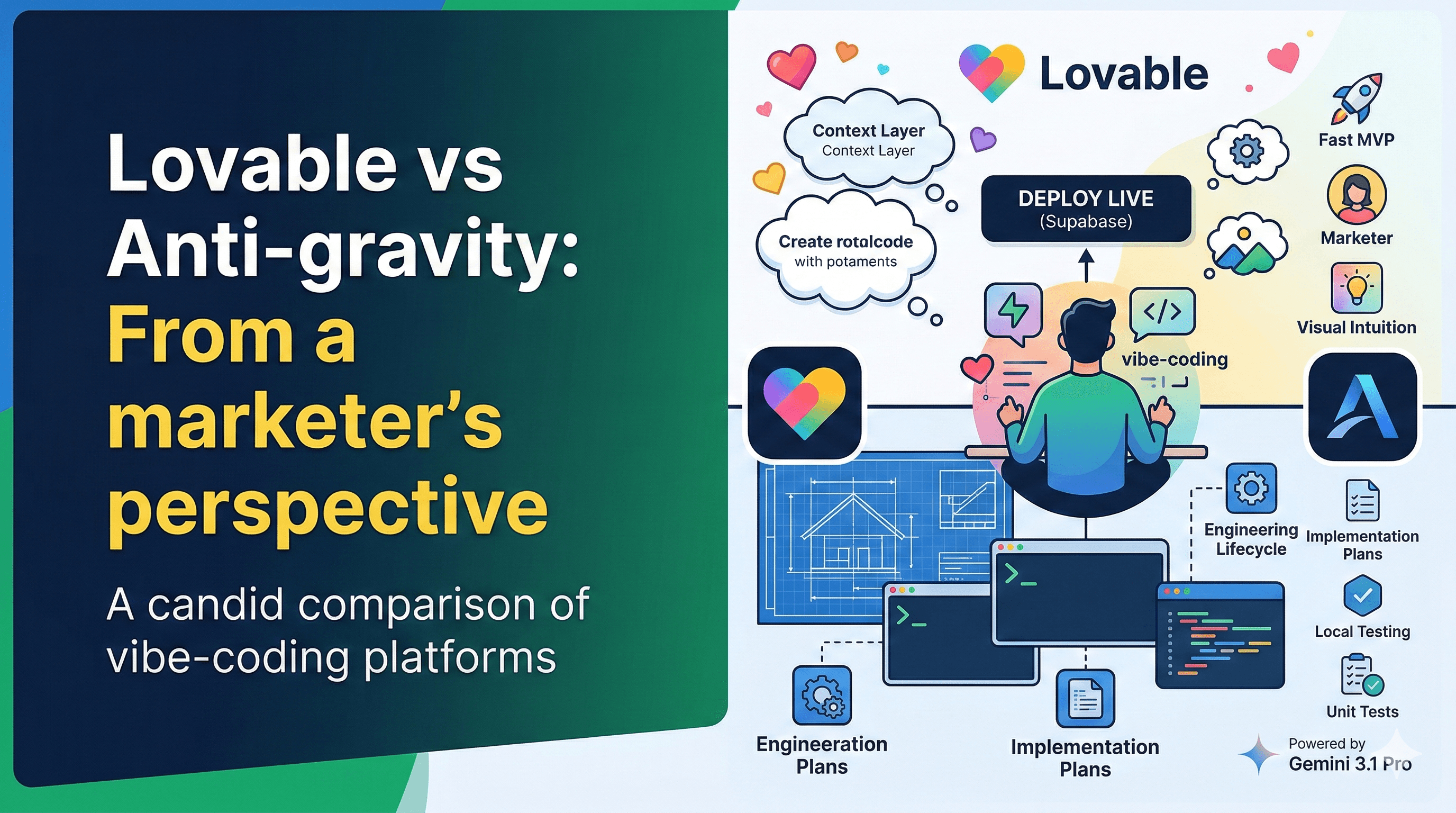
Lovable vs. Anti-gravity: Which AI coding tool is actually better for non-developers?
Insights
Feb 28, 2026

For years, marketers like me had ideas sitting in docs.
We knew what the product should do. We knew the positioning. We knew the landing page copy. But the moment it came to building, we had to wait.
Wait for developers.
Wait for sprints.
Wait for prioritization.
That bottleneck is disappearing.
I’ve been actively vibe-coding since the start of this year. I began with Lovable. Recently, I started experimenting with Antigravity as well. And the biggest shift for me isn’t which tool is better. It’s this:
Marketers can now ship products without a dev team.
Not perfectly. Not at scale. But enough to validate, iterate, and grow.
Let me explain.
My Background in “Vibe” Coding
To be frank, vibe-coding isn’t new for me. Back in 2023, when ChatGPT was in its nascent stages, I took its help to build my own documentation chatbot that reads through your help docs and answers your users’ queries. It took me two days to build this simple tool, as a lot of times GPT often started to hallucinate and give me wrong chunks of code.
Back in 2023, when ChatGPT was still finding its footing, I built my own documentation chatbot, one that reads through help docs and answers user queries. It took two days, mostly because GPT would hallucinate code chunks at random. Painful, but worth it. That experience gave me a decent baseline for evaluating AI coding tools.
I wanted to try Clause code as well. However, Claude doesn’t allow me to use it unless I’m on a paid plan. Purchasing Claude is out of budget right now, so maybe next month.
Now, before we dive deep into the differences, I need make one thing clear.
It’s not a straightforward, apples-to-apples comparison. Because both were built to cater to different use cases. But hey, I’m a marketer…I compare things for a living. 😆
When you sign up, the first thing you notice is the UX. So, I’ll start from there
User Experience (UX) & Workflow
This is where the biggest difference shows up immediately.
Lovable feels familiar. The interface resembles tools like ChatGPT and Gemini. The prompts are conversational. The workflow feels guided. You do not feel intimidated. It is clearly built with non-developers in mind. I did not have to think like an engineer. I just had to describe what I wanted.
Anti-Gravity is different. The moment you open it, you can sense it was designed for people who understand development workflows. It behaves more like an IDE assistant than a creative builder.
It plots implementation plans.
It breaks features into tasks.
It discusses architecture before writing code.
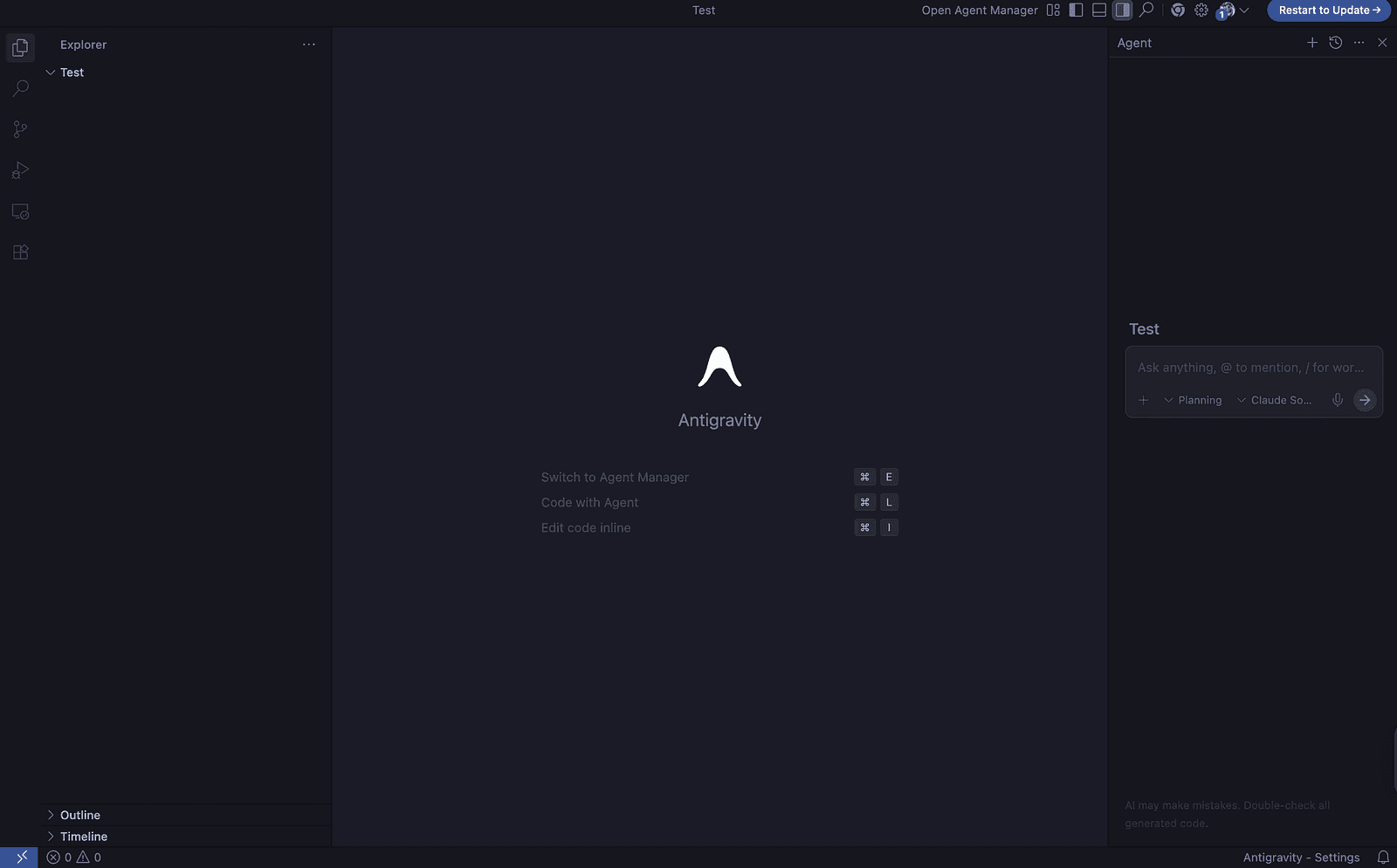
As a marketer, it took me time to adapt. It is not hard, but it is not instinctive either. Although the agent mode is just like chat-based Lovable, it wasn’t that explicit. I have some experience using IDE, so I was able to move around a bit to get things started
If you are someone who has never used an IDE before, Lovable feels easier to start with.
The “Context” Layer: Understanding the Ask
This is where Lovable genuinely stands out. Under the hood, Lovable is just a wrapper of models like Claude, ChatGPT, and Gemini. But what makes it powerful is the additional layer they have built on top of those models. I don’t know what they are called, but I’m calling it the “Context Layer”; it translates vague, human-sounding prompts into coherent product decisions. You don’t have to be precise. You just have to communicate, and it figures out the rest.
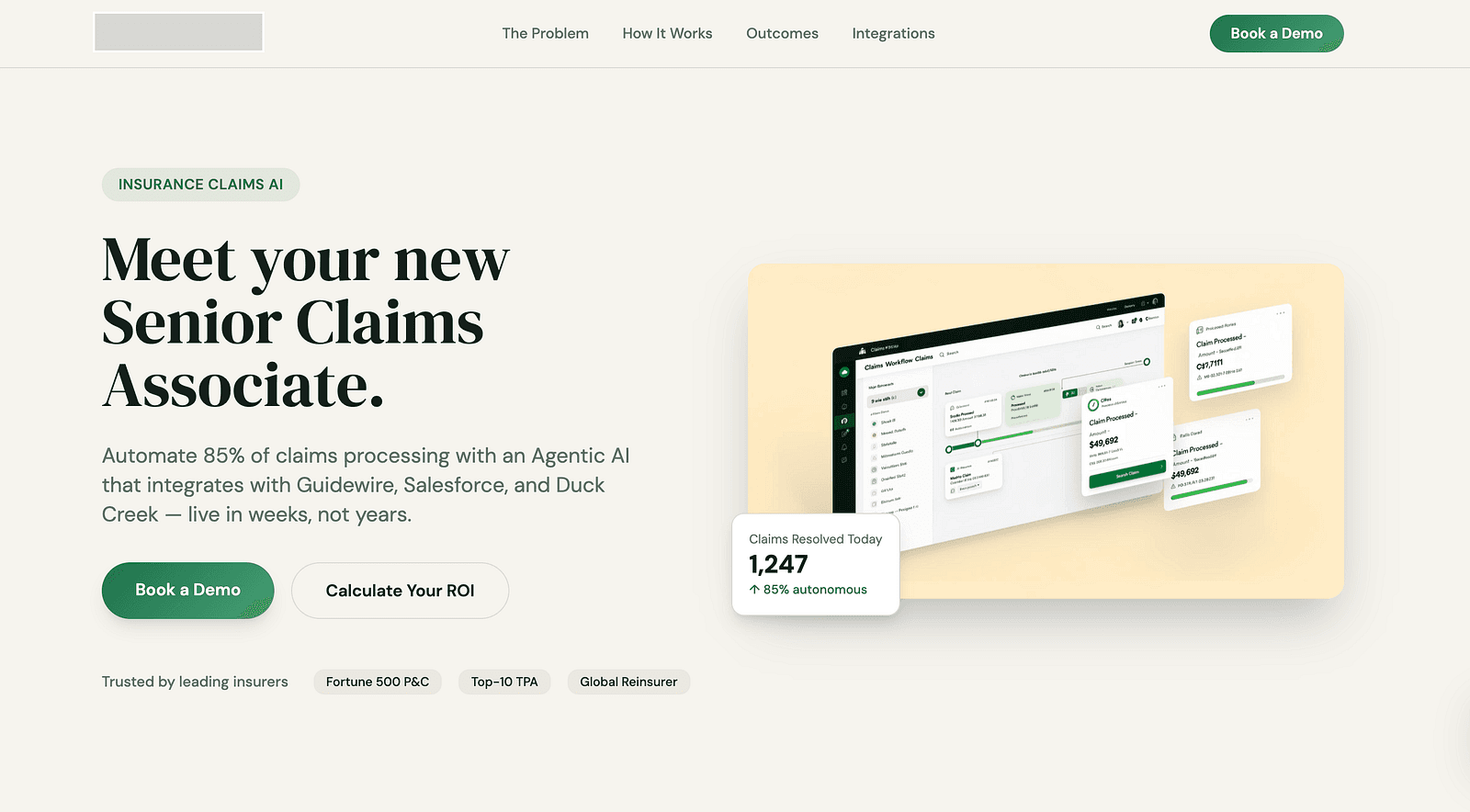
Because of this layer, Lovable has an excellent sense of visual direction. I recently asked it to create a landing page for an Enterprise SaaS product. Here is the prompt I gave:
I want to build a product landing page for X’s Insurance Agent. I want to replicate their own branding and get inspired by their micro animations as well. Here is the link: https:/company-name.com/. I’ve attached a screenshot of the landing page layout structure. Follow the same structure and expand the copy. I’ve also attached the positioning doc PDF for the insurance claims AI employee. Use that as a reference for writing copy
It took a couple of minutes, asked me 2–3 clarifying questions, and handed back a great-looking landing page. It even designed the hero image (though the image itself wasn’t quite up to the mark, I didn’t expect it to generate one at all). The output was polished, on-brand, and coherent, without me having to micromanage every decision.
To some extent, Lovable felt like me – a marketer who understands good design and product, but neither can code nor design.
When it comes to Antigravity, it lacks this Context layer. It understands requirements, too, but it’s more literal. I felt like it acted just like a crude engineer. It understands the raw requirements and does exactly what you ask. Even obvious design logic needs to be explicitly stated for it to be implemented.
There is no imaginative leap. No assumption of visual hierarchy. If I do not specify something, it usually does not exist. That can be good for precision. But from a marketer’s perspective, Lovable feels more aligned with how we think.
Development Workflow
This is where Anti-Gravity flips the script entirely.
It behaves like a junior engineer who wants to get things right.
Before writing code, it creates an implementation plan. It asks for approval. It discusses edge cases. The best and most interesting thing I saw is that it even emulates test cases and runs live tests. It identifies the issues on its own and tries to fix them as well. This alone makes the antigravity leap forward in the comparison.
Lovable does some planning, but not at that depth. It asks a couple of questions, and when you toggle on the "Plan" feature, it gives you the implementation plan. However, it consumes credits that cannot be controlled as well. It consumes as it wishes.
Anti-Gravity feels closer to replacing parts of the traditional development lifecycle. If I were running a small product team, I would seriously consider it to improve developer efficiency.
For solo marketers, though, that depth can feel like friction. Sometimes you just want to build and see it live.
Deployment & Real-World Scalability
Lovable is tightly integrated with Supabase, and deploying your app live is incredibly easy. I built a vibe-coded app named Ulavu using Lovable, and it now has 50 users. If you want to build a micro-app or an internal tool, it’s a great place to start.
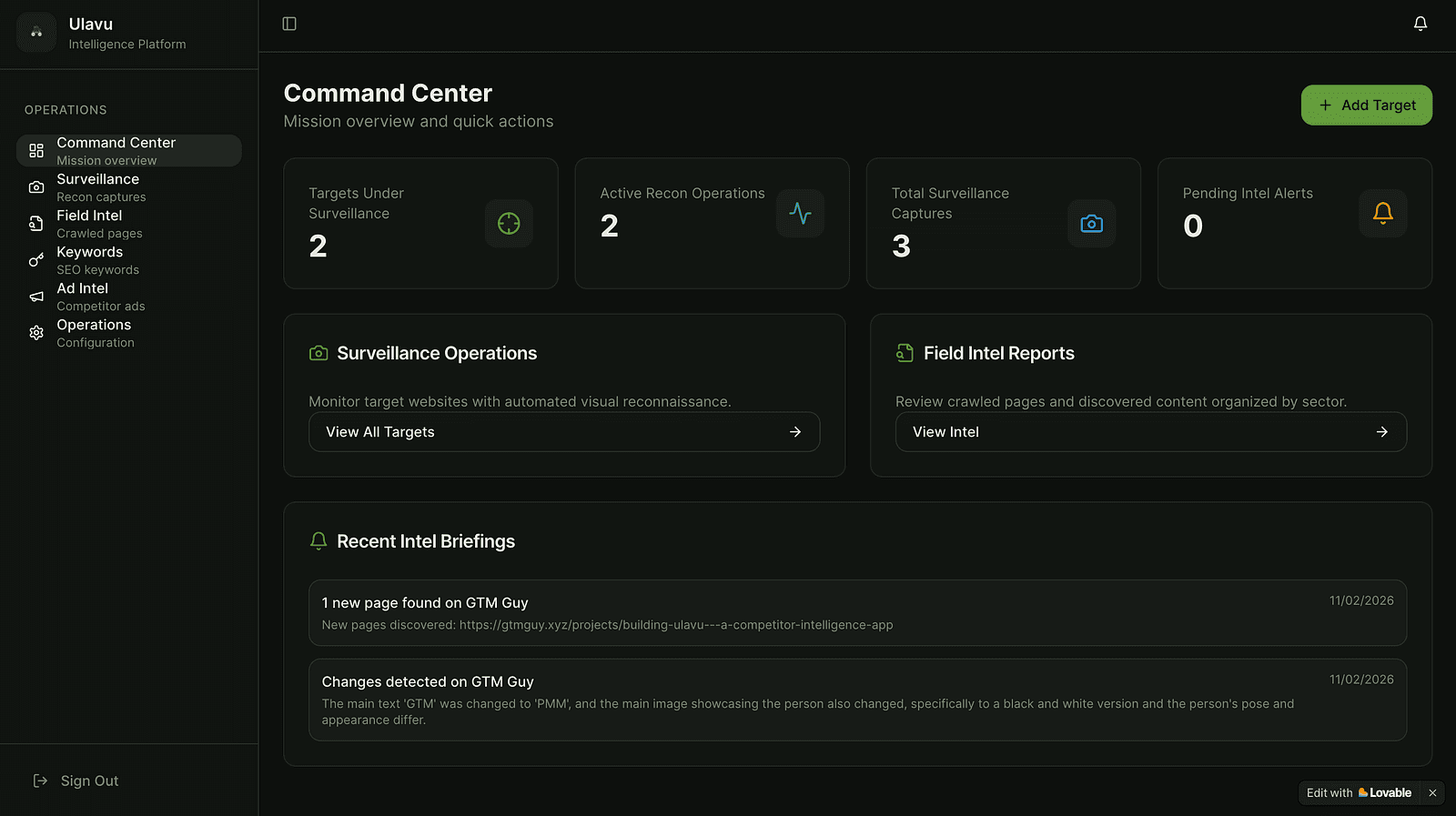
However, I’m not fully convinced Lovable can withstand a real-world stress test. Developers I’ve spoken to mentioned that while Supabase is popular, it doesn’t always cut it for building complex, enterprise-friendly products where you might need a more comprehensive database management system like AWS.
Anti-gravity doesn’t have a direct option to deploy your code live (or at least I haven’t found it yet). Whatever you build can only be tested locally. You’ll need some actual knowledge of how to deploy your product to production. Given this setup, Anti-gravity is definitely geared more toward smaller developer teams looking to improve their efficiency and speed up production deployment.
Output Quality
It’s interesting to look at what powers both tools. Lovable uses Gemini 3 Flash as its default. Anti-gravity uses the more advanced Gemini 3.1 Pro.
Designs are subjective. But in my opinion, despite having the better model under the hood, the UI that Anti-gravity generates simply isn’t on par with Lovable’s output. Lovable’s focus on the visual and contextual side wins out over raw model power here.
Managing Credits
Managing credits is a huge problem here. One clear pattern I noticed: Lovable is highly intelligent at the start of a session, but becomes noticeably dumber with every subsequent prompt. It feels like a way to exhaust your credits and push you toward a paid plan. I can’t really blame them; they have to make money, too.
In the case of Antigravity, this works completely differently. I have the Gemini Pro plan, so using Anti-gravity feels like I have unlimited credits. The trade-off? Because it lacks Lovable’s Context layer, you end up “paying” by having to provide much more granular, time-consuming instructions to get the work done.
So, Which One Should You Use?
Honestly, neither has fully won me over yet. The credits consumption rate in Lovable is what made me think of alternatives. What I did now is that I synced my GitHub with Lovable. All the updates I do via Lovable gets commited to my git. For further development, I cloned the project to my local and use it in Antigravity. This, however, is not an ideal setup. This starts a whole new bunch of issues. It’s like opening a pandora box of errors.
So, if you’re a marketer, founder, or non-technical builder trying to validate an idea fast, start with Lovable. It’s intuitive, it produces good-looking results quickly, and you can ship something real without knowing how to code.
If you’re part of a small dev team looking to build more reliably and improve code quality, Anti-Gravity is worth the learning curve. The structured workflow and automated testing make it a more serious tool for more serious builds.

More to Discover
Lovable vs Antigravity: From a marketer's perspective
Lovable vs. Anti-gravity: Which AI coding tool is actually better for non-developers?
Insights
Feb 28, 2026

For years, marketers like me had ideas sitting in docs.
We knew what the product should do. We knew the positioning. We knew the landing page copy. But the moment it came to building, we had to wait.
Wait for developers.
Wait for sprints.
Wait for prioritization.
That bottleneck is disappearing.
I’ve been actively vibe-coding since the start of this year. I began with Lovable. Recently, I started experimenting with Antigravity as well. And the biggest shift for me isn’t which tool is better. It’s this:
Marketers can now ship products without a dev team.
Not perfectly. Not at scale. But enough to validate, iterate, and grow.
Let me explain.
My Background in “Vibe” Coding
To be frank, vibe-coding isn’t new for me. Back in 2023, when ChatGPT was in its nascent stages, I took its help to build my own documentation chatbot that reads through your help docs and answers your users’ queries. It took me two days to build this simple tool, as a lot of times GPT often started to hallucinate and give me wrong chunks of code.
Back in 2023, when ChatGPT was still finding its footing, I built my own documentation chatbot, one that reads through help docs and answers user queries. It took two days, mostly because GPT would hallucinate code chunks at random. Painful, but worth it. That experience gave me a decent baseline for evaluating AI coding tools.
I wanted to try Clause code as well. However, Claude doesn’t allow me to use it unless I’m on a paid plan. Purchasing Claude is out of budget right now, so maybe next month.
Now, before we dive deep into the differences, I need make one thing clear.
It’s not a straightforward, apples-to-apples comparison. Because both were built to cater to different use cases. But hey, I’m a marketer…I compare things for a living. 😆
When you sign up, the first thing you notice is the UX. So, I’ll start from there
User Experience (UX) & Workflow
This is where the biggest difference shows up immediately.
Lovable feels familiar. The interface resembles tools like ChatGPT and Gemini. The prompts are conversational. The workflow feels guided. You do not feel intimidated. It is clearly built with non-developers in mind. I did not have to think like an engineer. I just had to describe what I wanted.
Anti-Gravity is different. The moment you open it, you can sense it was designed for people who understand development workflows. It behaves more like an IDE assistant than a creative builder.
It plots implementation plans.
It breaks features into tasks.
It discusses architecture before writing code.

As a marketer, it took me time to adapt. It is not hard, but it is not instinctive either. Although the agent mode is just like chat-based Lovable, it wasn’t that explicit. I have some experience using IDE, so I was able to move around a bit to get things started
If you are someone who has never used an IDE before, Lovable feels easier to start with.
The “Context” Layer: Understanding the Ask
This is where Lovable genuinely stands out. Under the hood, Lovable is just a wrapper of models like Claude, ChatGPT, and Gemini. But what makes it powerful is the additional layer they have built on top of those models. I don’t know what they are called, but I’m calling it the “Context Layer”; it translates vague, human-sounding prompts into coherent product decisions. You don’t have to be precise. You just have to communicate, and it figures out the rest.
Because of this layer, Lovable has an excellent sense of visual direction. I recently asked it to create a landing page for an Enterprise SaaS product. Here is the prompt I gave:
I want to build a product landing page for X’s Insurance Agent. I want to replicate their own branding and get inspired by their micro animations as well. Here is the link: https:/company-name.com/. I’ve attached a screenshot of the landing page layout structure. Follow the same structure and expand the copy. I’ve also attached the positioning doc PDF for the insurance claims AI employee. Use that as a reference for writing copy
It took a couple of minutes, asked me 2–3 clarifying questions, and handed back a great-looking landing page. It even designed the hero image (though the image itself wasn’t quite up to the mark, I didn’t expect it to generate one at all). The output was polished, on-brand, and coherent, without me having to micromanage every decision.

To some extent, Lovable felt like me – a marketer who understands good design and product, but neither can code nor design.
When it comes to Antigravity, it lacks this Context layer. It understands requirements, too, but it’s more literal. I felt like it acted just like a crude engineer. It understands the raw requirements and does exactly what you ask. Even obvious design logic needs to be explicitly stated for it to be implemented.
There is no imaginative leap. No assumption of visual hierarchy. If I do not specify something, it usually does not exist. That can be good for precision. But from a marketer’s perspective, Lovable feels more aligned with how we think.
Development Workflow
This is where Anti-Gravity flips the script entirely.
It behaves like a junior engineer who wants to get things right.
Before writing code, it creates an implementation plan. It asks for approval. It discusses edge cases. The best and most interesting thing I saw is that it even emulates test cases and runs live tests. It identifies the issues on its own and tries to fix them as well. This alone makes the antigravity leap forward in the comparison.
Lovable does some planning, but not at that depth. It asks a couple of questions, and when you toggle on the "Plan" feature, it gives you the implementation plan. However, it consumes credits that cannot be controlled as well. It consumes as it wishes.
Anti-Gravity feels closer to replacing parts of the traditional development lifecycle. If I were running a small product team, I would seriously consider it to improve developer efficiency.
For solo marketers, though, that depth can feel like friction. Sometimes you just want to build and see it live.
Deployment & Real-World Scalability
Lovable is tightly integrated with Supabase, and deploying your app live is incredibly easy. I built a vibe-coded app named Ulavu using Lovable, and it now has 50 users. If you want to build a micro-app or an internal tool, it’s a great place to start.

However, I’m not fully convinced Lovable can withstand a real-world stress test. Developers I’ve spoken to mentioned that while Supabase is popular, it doesn’t always cut it for building complex, enterprise-friendly products where you might need a more comprehensive database management system like AWS.
Anti-gravity doesn’t have a direct option to deploy your code live (or at least I haven’t found it yet). Whatever you build can only be tested locally. You’ll need some actual knowledge of how to deploy your product to production. Given this setup, Anti-gravity is definitely geared more toward smaller developer teams looking to improve their efficiency and speed up production deployment.
Output Quality
It’s interesting to look at what powers both tools. Lovable uses Gemini 3 Flash as its default. Anti-gravity uses the more advanced Gemini 3.1 Pro.
Designs are subjective. But in my opinion, despite having the better model under the hood, the UI that Anti-gravity generates simply isn’t on par with Lovable’s output. Lovable’s focus on the visual and contextual side wins out over raw model power here.
Managing Credits
Managing credits is a huge problem here. One clear pattern I noticed: Lovable is highly intelligent at the start of a session, but becomes noticeably dumber with every subsequent prompt. It feels like a way to exhaust your credits and push you toward a paid plan. I can’t really blame them; they have to make money, too.
In the case of Antigravity, this works completely differently. I have the Gemini Pro plan, so using Anti-gravity feels like I have unlimited credits. The trade-off? Because it lacks Lovable’s Context layer, you end up “paying” by having to provide much more granular, time-consuming instructions to get the work done.
So, Which One Should You Use?
Honestly, neither has fully won me over yet. The credits consumption rate in Lovable is what made me think of alternatives. What I did now is that I synced my GitHub with Lovable. All the updates I do via Lovable gets commited to my git. For further development, I cloned the project to my local and use it in Antigravity. This, however, is not an ideal setup. This starts a whole new bunch of issues. It’s like opening a pandora box of errors.
So, if you’re a marketer, founder, or non-technical builder trying to validate an idea fast, start with Lovable. It’s intuitive, it produces good-looking results quickly, and you can ship something real without knowing how to code.
If you’re part of a small dev team looking to build more reliably and improve code quality, Anti-Gravity is worth the learning curve. The structured workflow and automated testing make it a more serious tool for more serious builds.


More to Discover
Lovable vs Antigravity: From a marketer's perspective
Lovable vs. Anti-gravity: Which AI coding tool is actually better for non-developers?
Insights
Feb 28, 2026

For years, marketers like me had ideas sitting in docs.
We knew what the product should do. We knew the positioning. We knew the landing page copy. But the moment it came to building, we had to wait.
Wait for developers.
Wait for sprints.
Wait for prioritization.
That bottleneck is disappearing.
I’ve been actively vibe-coding since the start of this year. I began with Lovable. Recently, I started experimenting with Antigravity as well. And the biggest shift for me isn’t which tool is better. It’s this:
Marketers can now ship products without a dev team.
Not perfectly. Not at scale. But enough to validate, iterate, and grow.
Let me explain.
My Background in “Vibe” Coding
To be frank, vibe-coding isn’t new for me. Back in 2023, when ChatGPT was in its nascent stages, I took its help to build my own documentation chatbot that reads through your help docs and answers your users’ queries. It took me two days to build this simple tool, as a lot of times GPT often started to hallucinate and give me wrong chunks of code.
Back in 2023, when ChatGPT was still finding its footing, I built my own documentation chatbot, one that reads through help docs and answers user queries. It took two days, mostly because GPT would hallucinate code chunks at random. Painful, but worth it. That experience gave me a decent baseline for evaluating AI coding tools.
I wanted to try Clause code as well. However, Claude doesn’t allow me to use it unless I’m on a paid plan. Purchasing Claude is out of budget right now, so maybe next month.
Now, before we dive deep into the differences, I need make one thing clear.
It’s not a straightforward, apples-to-apples comparison. Because both were built to cater to different use cases. But hey, I’m a marketer…I compare things for a living. 😆
When you sign up, the first thing you notice is the UX. So, I’ll start from there
User Experience (UX) & Workflow
This is where the biggest difference shows up immediately.
Lovable feels familiar. The interface resembles tools like ChatGPT and Gemini. The prompts are conversational. The workflow feels guided. You do not feel intimidated. It is clearly built with non-developers in mind. I did not have to think like an engineer. I just had to describe what I wanted.
Anti-Gravity is different. The moment you open it, you can sense it was designed for people who understand development workflows. It behaves more like an IDE assistant than a creative builder.
It plots implementation plans.
It breaks features into tasks.
It discusses architecture before writing code.

As a marketer, it took me time to adapt. It is not hard, but it is not instinctive either. Although the agent mode is just like chat-based Lovable, it wasn’t that explicit. I have some experience using IDE, so I was able to move around a bit to get things started
If you are someone who has never used an IDE before, Lovable feels easier to start with.
The “Context” Layer: Understanding the Ask
This is where Lovable genuinely stands out. Under the hood, Lovable is just a wrapper of models like Claude, ChatGPT, and Gemini. But what makes it powerful is the additional layer they have built on top of those models. I don’t know what they are called, but I’m calling it the “Context Layer”; it translates vague, human-sounding prompts into coherent product decisions. You don’t have to be precise. You just have to communicate, and it figures out the rest.
Because of this layer, Lovable has an excellent sense of visual direction. I recently asked it to create a landing page for an Enterprise SaaS product. Here is the prompt I gave:
I want to build a product landing page for X’s Insurance Agent. I want to replicate their own branding and get inspired by their micro animations as well. Here is the link: https:/company-name.com/. I’ve attached a screenshot of the landing page layout structure. Follow the same structure and expand the copy. I’ve also attached the positioning doc PDF for the insurance claims AI employee. Use that as a reference for writing copy
It took a couple of minutes, asked me 2–3 clarifying questions, and handed back a great-looking landing page. It even designed the hero image (though the image itself wasn’t quite up to the mark, I didn’t expect it to generate one at all). The output was polished, on-brand, and coherent, without me having to micromanage every decision.

To some extent, Lovable felt like me – a marketer who understands good design and product, but neither can code nor design.
When it comes to Antigravity, it lacks this Context layer. It understands requirements, too, but it’s more literal. I felt like it acted just like a crude engineer. It understands the raw requirements and does exactly what you ask. Even obvious design logic needs to be explicitly stated for it to be implemented.
There is no imaginative leap. No assumption of visual hierarchy. If I do not specify something, it usually does not exist. That can be good for precision. But from a marketer’s perspective, Lovable feels more aligned with how we think.
Development Workflow
This is where Anti-Gravity flips the script entirely.
It behaves like a junior engineer who wants to get things right.
Before writing code, it creates an implementation plan. It asks for approval. It discusses edge cases. The best and most interesting thing I saw is that it even emulates test cases and runs live tests. It identifies the issues on its own and tries to fix them as well. This alone makes the antigravity leap forward in the comparison.
Lovable does some planning, but not at that depth. It asks a couple of questions, and when you toggle on the "Plan" feature, it gives you the implementation plan. However, it consumes credits that cannot be controlled as well. It consumes as it wishes.
Anti-Gravity feels closer to replacing parts of the traditional development lifecycle. If I were running a small product team, I would seriously consider it to improve developer efficiency.
For solo marketers, though, that depth can feel like friction. Sometimes you just want to build and see it live.
Deployment & Real-World Scalability
Lovable is tightly integrated with Supabase, and deploying your app live is incredibly easy. I built a vibe-coded app named Ulavu using Lovable, and it now has 50 users. If you want to build a micro-app or an internal tool, it’s a great place to start.

However, I’m not fully convinced Lovable can withstand a real-world stress test. Developers I’ve spoken to mentioned that while Supabase is popular, it doesn’t always cut it for building complex, enterprise-friendly products where you might need a more comprehensive database management system like AWS.
Anti-gravity doesn’t have a direct option to deploy your code live (or at least I haven’t found it yet). Whatever you build can only be tested locally. You’ll need some actual knowledge of how to deploy your product to production. Given this setup, Anti-gravity is definitely geared more toward smaller developer teams looking to improve their efficiency and speed up production deployment.
Output Quality
It’s interesting to look at what powers both tools. Lovable uses Gemini 3 Flash as its default. Anti-gravity uses the more advanced Gemini 3.1 Pro.
Designs are subjective. But in my opinion, despite having the better model under the hood, the UI that Anti-gravity generates simply isn’t on par with Lovable’s output. Lovable’s focus on the visual and contextual side wins out over raw model power here.
Managing Credits
Managing credits is a huge problem here. One clear pattern I noticed: Lovable is highly intelligent at the start of a session, but becomes noticeably dumber with every subsequent prompt. It feels like a way to exhaust your credits and push you toward a paid plan. I can’t really blame them; they have to make money, too.
In the case of Antigravity, this works completely differently. I have the Gemini Pro plan, so using Anti-gravity feels like I have unlimited credits. The trade-off? Because it lacks Lovable’s Context layer, you end up “paying” by having to provide much more granular, time-consuming instructions to get the work done.
So, Which One Should You Use?
Honestly, neither has fully won me over yet. The credits consumption rate in Lovable is what made me think of alternatives. What I did now is that I synced my GitHub with Lovable. All the updates I do via Lovable gets commited to my git. For further development, I cloned the project to my local and use it in Antigravity. This, however, is not an ideal setup. This starts a whole new bunch of issues. It’s like opening a pandora box of errors.
So, if you’re a marketer, founder, or non-technical builder trying to validate an idea fast, start with Lovable. It’s intuitive, it produces good-looking results quickly, and you can ship something real without knowing how to code.
If you’re part of a small dev team looking to build more reliably and improve code quality, Anti-Gravity is worth the learning curve. The structured workflow and automated testing make it a more serious tool for more serious builds.


