Portfolio
Building Gushwork’s Sales Enablement System
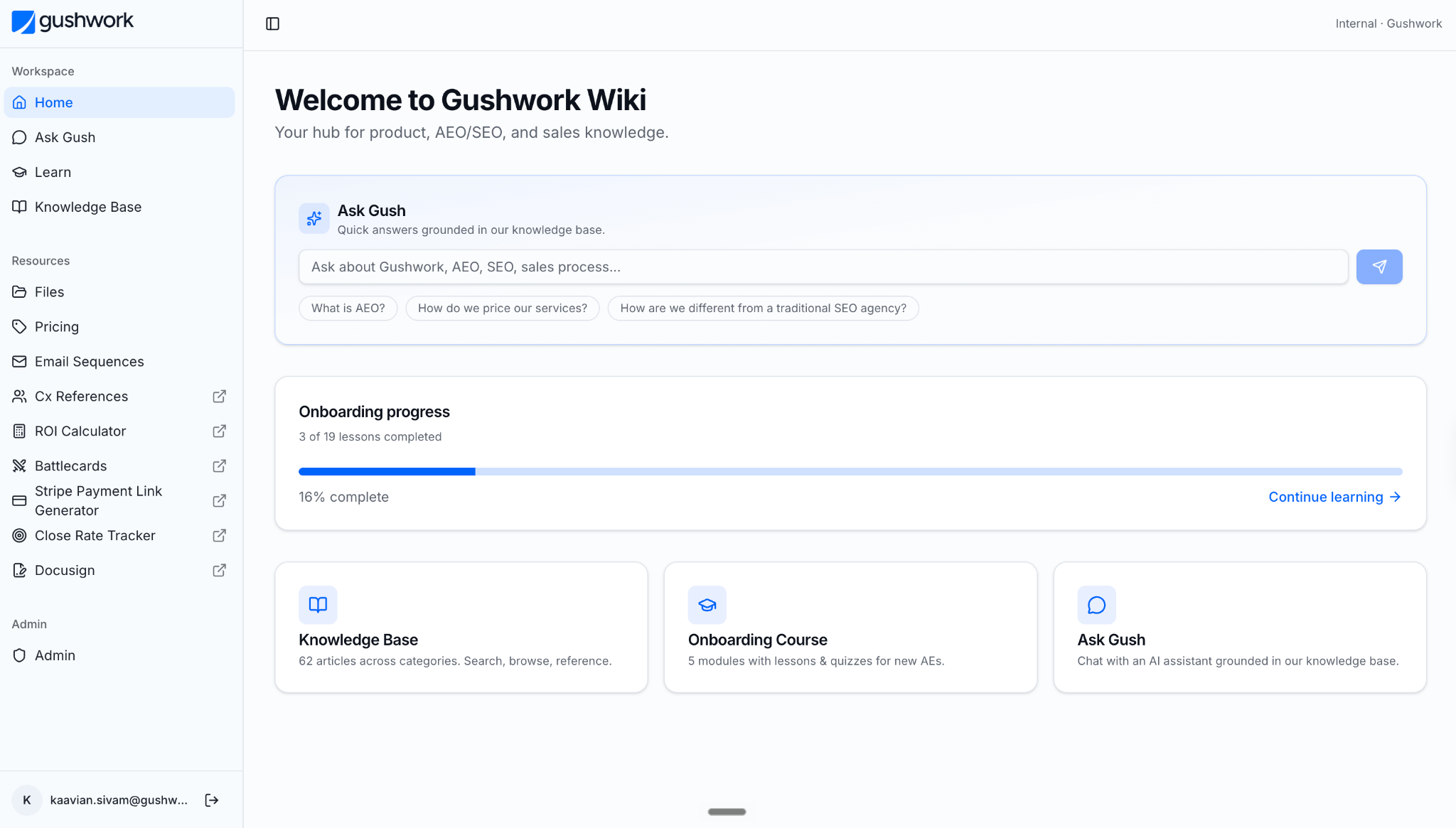
Built an AI sales hub that turned scattered product and sales knowledge into a single operating system for AEs.
Problem :
When I joined Gushwork as its founding Product Marketer, the sales team was scaling faster than the enablement around it. AEs had a product demo and a sales deck, but most of the knowledge needed to sell effectively lived across call recordings, Slack threads, internal documents, or with individual team members. There were no structured battlecards, industry-specific proof points, standardized follow-up sequences, or a single place an AE could go to answer a product, positioning, or objection-handling question. As the team grew, this created an obvious risk: every AE could end up selling a slightly different version of Gushwork.
Challenge :
The problem was not simply a lack of collateral. Gushwork was selling a relatively new product to founders and sales leaders across manufacturing, distribution, services, and SaaS. Prospects came into calls with very different levels of understanding and repeatedly compared us with agencies, internal teams, DIY AI tools, and emerging AI-search products. At the same time, the product and positioning were changing quickly. A static wiki would become outdated almost immediately. I needed to build an enablement system that made existing knowledge easier to use while continuously learning from what was happening on real sales calls.allenge.
Solution :
I built Gushwork's sales enablement function from the ground up and centralized it into an AI sales hub that AEs could use as their primary source of truth. I started with sales conversations, not collateral. I reviewed AE calls and worked with the sales team to map recurring objections, competitor mentions, product questions, discovery gaps, and language that prospects responded to. This gave me the information architecture for the hub rather than building it around what I assumed sellers needed. I built the core sales knowledge base. I consolidated product knowledge, positioning, ICP context, proof points, objection handling, competitive guidance, and frequently asked questions into a structured AE wiki. I also codified what sellers should and should not say so that messaging stayed consistent as the company evolved. I created the missing selling assets around it. The system brought together competitive battlecards, industry case studies, one-pagers, pre-call and post-call sequences, proof points, demo guidance, and objection-handling frameworks. Instead of searching through different folders and Slack threads, AEs had one place to start. I turned the hub into an AI-assisted sales resource. Rather than making sellers manually navigate a large knowledge base, I built the hub so they could ask sales and product questions directly and retrieve the relevant answer. The goal was to make the system useful during the flow of selling, not simply create another repository of documents. I built a feedback loop from calls back into enablement. I continued reviewing sales conversations every week for new objections, competitor references, messaging inconsistencies, and knowledge gaps. Those findings fed back into battlecards, seller guidance, positioning, case-study priorities, and the hub itself. The result was not a finished sales wiki. It was a living enablement system that improved as the sales team learned.
Impact :
- Reduced recurring questions from AEs by approximately 30% by giving sellers a reliable self-serve source for product and sales knowledge. - Saw a 23% reduction in sales-cycle length during the period after the enablement system was rolled out. - Created a consistent sales narrative across objection handling, competitive conversations, follow-ups, demos, and customer proof. - Turned sales calls into a continuous source of PMM insight instead of treating enablement as a one-time collateral project.
Summary :
Built Gushwork’s sales enablement function from zero into an AI-assisted sales hub, combining seller knowledge, competitive intelligence, proof, messaging, and call insights into a continuously improving system for the sales team.